

2026 - Volume #50, Issue #4, Page #06
[ Sample Stories From This Issue | List of All Stories In This Issue | Print this story
| Read this issue]
Hickory Oil Offers Impressive Harvest Potential
 |

“Hickory oil allows me to farm without owning land,” he says. “Most everyone I’ve asked has been happy to let me harvest from their wild trees.”
The yellowbud hickory is native throughout the eastern United States. It’s often found along margins such as ditches, forest edges and back pastures, and it can be easily identified by its pointed sulfur-yellow buds. You can also look for gently ridged bark with an interlacing diamond pattern and compound leaves with seven to eleven pinnately compound leaflets.
“Tree crops come with several perks,” says Geyer. “They don’t require planting each year, they don’t require tillage, they can be integrated with livestock, their roots hold the soil in place and improve water infiltration, and they can be used for firewood when you’re done with them.”
He also highlights the benefits of having different tree species within one area.
“With enough diversity, you don’t have to spray for pests. You end up with a very low-input system (except for labor), which is perfect for weathering a recession or rising oil prices.”
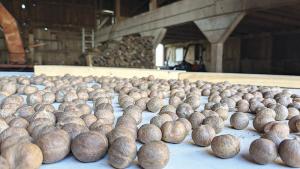
Yellowbud hickory nuts are a largely untapped source of cooking oil. The thin-shelled nuts that fall from trees contain kernels so rich in oil that the oil can be squeezed out between the fingertips.
Geyer reports that three 5-gal. buckets of nuts can yield a gallon of oil. Most foragers can expect to harvest between one and three buckets per hour under a promising tree. While nut trees have low and high years, even in low years, some trees still perform above expectations.
All hickory nuts have a thin outer husk that must be removed shortly after harvest. Then the nuts are placed in a drying bin with airflow.
“Once they’re dry, they get sorted to remove the bad nuts that turn a darker shade of brown,” Geyer says. “Then they’re pre-crushed in a roller mill and fed into a screw expeller press. Finally, the oil is filtered with a filter press or centrifuge, then bottled for sale.”
While the nuts themselves are bitter, their tannins aren’t oil-soluble and are naturally removed during pressing.
Healthy oils are difficult to grow and source locally and sustainably. Cold-pressed hickory oil has a fatty acid profile comparable to olive oil, with a milder, nutty flavor and a smoke point of 405 F. The oil can be used to sauté vegetables, make salad dressing, roast squash and potatoes, and bake bread and desserts.
Geyer shares the bounty from his free forest harvests by planting hickory trees each spring in his local community.
“My goal is for everyone who wants to be able to harvest nuts, whether for food or a little extra cash.”
He takes full advantage of his supply in everyday life.
“The oil is amazing. My fiancé and I eat about a quarter cup a day as our main fat source. People buy it for $20 for an 8-oz bottle or $240 a gallon for bulk oil. Once more people start doing it and scale up a bit, I think the price will drop, but with enough volume, I can still pay $1 per pound for nuts and be profitable.”
Today at Fancy Twig Farm, Geyer continues researching new processing equipment and procedures for husk removal, drying, crushing, pressing and oil purification. He’s quick to note that he’s far from the first to use hickory oil.
“Indigenous people used yellowbud hickories. They lived here for 10,000+ years and kept the soil in Iowa at about 8% organic matter. In 200 years of being here, we’ve dropped that to 2%. We could learn a thing or two from them.”
Contact: FARM SHOW Followup, Levi Geyer, Fancy Twig Farm (ph 319-259-2196; levi@fancytwigfarm.com; www.fancytwigfarm.com).

Click here to read entire issue
To read the rest of this story, download this issue below or click here to register with your account number.


