Wood Stove Pushes Out Heat
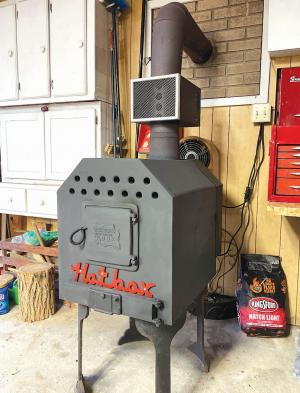 ✖  |
Jerry Carra captures as much heat as he can from the wood he burns in the stove he built. The air box and heating tubes at the top of the stove, along with the stack robber above it, are anything but passive. Each has its own fan that pushes air through, heating it as it goes and releasing the hot air into his garage-bay woodshop.
“When I lived and worked in Alaska as a young man, a friend of mine built a stove using a 55-gal. drum,” recalls Carra. “He had a water tank and copper tubes that ran inside the stove and up to a car radiator above it. A fan on the radiator pushed air through it to warm the room. I didn’t want something that complicated, but I wanted the same effect.”
Carra fabricated his stove body from 1/4-in., 1020 low-carbon, mild steel. The main fire box measures about 21 in. wide, 24 in. deep and 24 in. high. The 10-in. top of the fire box angles in by about 5 in. on each side, forming a heat-concentrating trapezoid.
“I welded 13 1-in. pipes through the top of the firebox,” says Carra. “On the back side, I made an air box that’s about 4 in. deep and open to the bottom. A squirrel-cage fan below the air box pulls cool air from the floor and pushes it through the tubes and into the woodshop.”
As if that wasn’t efficient enough, his grown children bought him a stack robber for Christmas. Like his stove, it has tubes and a fan to capture excess heat from the stovepipe.
“The stack robbers were popular in Alaska,” recalls Carra. “They’re easy to find on Amazon.”
He built his wood grate from a 1-in. deep and 1-in. wide metal walkway grate. A small door for cleaning out ashes beneath the grate is located at the front bottom. A larger door for loading wood into the firebox is centered on the front. The large door was a lucky find.
“I ran across an old wood stove in the woods while deer hunting, and the door was still in good shape, so I brought it home,” says Carra. “I had no idea at the time that I would have a use for it.”
Aside from the recycled door and the gifted stack robber, the rest of the stove was fabricated in Carra’s shop, including the name “Hotbox.”
“I cut the name out of steel plate with a cutting torch, cleaned it up with a grinder, and painted it,” says Carra. “The name fits. Start a fire with a little wood in the morning, and the pipes are red hot in no time. It heats up my wood shop fast.”
Contact: FARM SHOW Followup, Jerry Carra, 104 Dogwood Dr., Grayson, Ky. 41143 (ph 606-474-4919).

Click here to read entire issue
Wood Stove Pushes Out Heat
Jerry Carra captures as much heat as he can from the wood he burns in the stove he built. The air box and heating tubes at the top of the stove, along with the stack robber above it, are anything but passive. Each has its own fan that pushes air through, heating it as it goes and releasing the hot air into his garage-bay woodshop.
“When I lived and worked in Alaska as a young man, a friend of mine built a stove using a 55-gal. drum,” recalls Carra. “He had a water tank and copper tubes that ran inside the stove and up to a car radiator above it. A fan on the radiator pushed air through it to warm the room. I didn’t want something that complicated, but I wanted the same effect.”
Carra fabricated his stove body from 1/4-in., 1020 low-carbon, mild steel. The main fire box measures about 21 in. wide, 24 in. deep and 24 in. high. The 10-in. top of the fire box angles in by about 5 in. on each side, forming a heat-concentrating trapezoid.
“I welded 13 1-in. pipes through the top of the firebox,” says Carra. “On the back side, I made an air box that’s about 4 in. deep and open to the bottom. A squirrel-cage fan below the air box pulls cool air from the floor and pushes it through the tubes and into the woodshop.”
As if that wasn’t efficient enough, his grown children bought him a stack robber for Christmas. Like his stove, it has tubes and a fan to capture excess heat from the stovepipe.
“The stack robbers were popular in Alaska,” recalls Carra. “They’re easy to find on Amazon.”
He built his wood grate from a 1-in. deep and 1-in. wide metal walkway grate. A small door for cleaning out ashes beneath the grate is located at the front bottom. A larger door for loading wood into the firebox is centered on the front. The large door was a lucky find.
“I ran across an old wood stove in the woods while deer hunting, and the door was still in good shape, so I brought it home,” says Carra. “I had no idea at the time that I would have a use for it.”
Aside from the recycled door and the gifted stack robber, the rest of the stove was fabricated in Carra’s shop, including the name “Hotbox.”
“I cut the name out of steel plate with a cutting torch, cleaned it up with a grinder, and painted it,” says Carra. “The name fits. Start a fire with a little wood in the morning, and the pipes are red hot in no time. It heats up my wood shop fast.”
Contact: FARM SHOW Followup, Jerry Carra, 104 Dogwood Dr., Grayson, Ky. 41143 (ph 606-474-4919).
To read the rest of this story, download this issue below or click
here to register with your account number.


