World Food Prize Recognizes Advances In Sustainable Agriculture
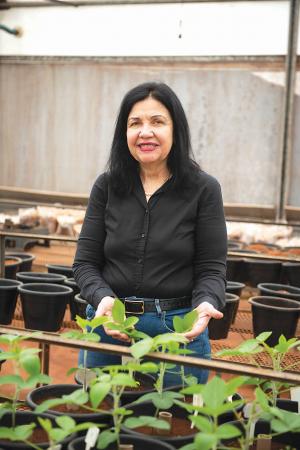 ✖  |
Dr. Mariangela Hungria, a microbiologist from São Paulo and a researcher at the Embrapa Soybean Center in Londrina, Brazil, has been named the 2025 World Food Prize Laureate for her groundbreaking contributions to agricultural science.
The prestigious $500,000 award recognizes Dr. Hungria’s contributions to creating safe, affordable, nutritious, sustainable and equitable food systems worldwide.
The award ceremony took place at Community Choice Event Center in Des Moines and was led by Iowa Governor Kim Reynolds and announced by Foundation President Mashal Husain, with remarks from Board Chair Paul Schickler and Foundation CEO Tom Vilsack.
Over four decades, Dr. Hungria developed numerous biological seed and soil treatments that enable crops to better access nutrients through soil bacteria. Her early advocacy for biological nitrogen fixation has boosted yields and reduced reliance on synthetic fertilizers, which are extremely expensive, pollute rivers and reservoirs, and emit high levels of greenhouse gases.
At a time when soil science was male-dominated and focused on chemicals, Dr. Hungria championed sustainable methods that harness natural bacteria to reduce costs and environmental impacts.
“Winning this award is like the Nobel of agriculture, and it was something I never expected in my life,” Dr. Hungria says. “I wasn’t aware of my nomination and was surprised when they called me and said I was the winner. I’m just a Brazilian researcher fighting her whole life for research funding and had no expectations of competing with other applicants, but it’s extremely important for me as it’s the prize for my lifetime.”
She explains that when she was attending university, she only had classes about chemicals.
“We were at the top of the Green Revolution, where plant breeding and chemical fertilizers were considered mandatory for high production,” she says. “I knew inside, and I never doubted that there was room for biologicals. I understood that to be successful, I must achieve the highest yields as possible using biologicals.”
Dr. Hungria conducted research to identify the optimal microorganisms and technologies for achieving high yields. At the soybean center, she identified the best methods and then demonstrated their effectiveness directly to farmers. Her efforts contributed to Brazil’s leadership in agricultural biologicals, showcasing practical results beyond the lab and experimental fields.
Dr. Hungria’s microbial inoculants are used on 85% of Brazil’s soybean fields, covering more than 40 million hectares. They save farmers $25 billion annually, reduce CO2 emissions by 230 million metric tons, and deliver yields higher than those achieved with synthetic fertilizers. Her innovations have also been adopted worldwide.
“It was a dream to receive this prize, and the response from newspapers and the internet has been fantastic,” she says. “It’s an amazing opportunity to show that the use of biologicals replacing chemicals in agriculture is a feasible technology.”
She believes this recognition has also shed light on women in agriculture and in science.
“Many women have reached out, inspired to see themselves in my journey, proving that, with dedication, dreams like advancing sustainable farming through biologicals are possible, regardless of gender.”
The award includes a financial prize, which Dr. Hungria will use to establish an institution that will provide awards to women who are making a positive impact globally.
“I’m hopeful that this institution will be launched soon, supporting and inspiring women leaders in agriculture and science.”
Contact: FARM SHOW Followup, Dr. Mariangela Hungria, Embrapa Soybean Center Researcher, Londrina, Brazil (mariangela.hungria@embrapa.br).

Click here to read entire issue
World Food Prize Recognizes Advances In Sustainable Agriculture
Dr. Mariangela Hungria, a microbiologist from São Paulo and a researcher at the Embrapa Soybean Center in Londrina, Brazil, has been named the 2025 World Food Prize Laureate for her groundbreaking contributions to agricultural science.
The prestigious $500,000 award recognizes Dr. Hungria’s contributions to creating safe, affordable, nutritious, sustainable and equitable food systems worldwide.
The award ceremony took place at Community Choice Event Center in Des Moines and was led by Iowa Governor Kim Reynolds and announced by Foundation President Mashal Husain, with remarks from Board Chair Paul Schickler and Foundation CEO Tom Vilsack.
Over four decades, Dr. Hungria developed numerous biological seed and soil treatments that enable crops to better access nutrients through soil bacteria. Her early advocacy for biological nitrogen fixation has boosted yields and reduced reliance on synthetic fertilizers, which are extremely expensive, pollute rivers and reservoirs, and emit high levels of greenhouse gases.
At a time when soil science was male-dominated and focused on chemicals, Dr. Hungria championed sustainable methods that harness natural bacteria to reduce costs and environmental impacts.
“Winning this award is like the Nobel of agriculture, and it was something I never expected in my life,” Dr. Hungria says. “I wasn’t aware of my nomination and was surprised when they called me and said I was the winner. I’m just a Brazilian researcher fighting her whole life for research funding and had no expectations of competing with other applicants, but it’s extremely important for me as it’s the prize for my lifetime.”
She explains that when she was attending university, she only had classes about chemicals.
“We were at the top of the Green Revolution, where plant breeding and chemical fertilizers were considered mandatory for high production,” she says. “I knew inside, and I never doubted that there was room for biologicals. I understood that to be successful, I must achieve the highest yields as possible using biologicals.”
Dr. Hungria conducted research to identify the optimal microorganisms and technologies for achieving high yields. At the soybean center, she identified the best methods and then demonstrated their effectiveness directly to farmers. Her efforts contributed to Brazil’s leadership in agricultural biologicals, showcasing practical results beyond the lab and experimental fields.
Dr. Hungria’s microbial inoculants are used on 85% of Brazil’s soybean fields, covering more than 40 million hectares. They save farmers $25 billion annually, reduce CO2 emissions by 230 million metric tons, and deliver yields higher than those achieved with synthetic fertilizers. Her innovations have also been adopted worldwide.
“It was a dream to receive this prize, and the response from newspapers and the internet has been fantastic,” she says. “It’s an amazing opportunity to show that the use of biologicals replacing chemicals in agriculture is a feasible technology.”
She believes this recognition has also shed light on women in agriculture and in science.
“Many women have reached out, inspired to see themselves in my journey, proving that, with dedication, dreams like advancing sustainable farming through biologicals are possible, regardless of gender.”
The award includes a financial prize, which Dr. Hungria will use to establish an institution that will provide awards to women who are making a positive impact globally.
“I’m hopeful that this institution will be launched soon, supporting and inspiring women leaders in agriculture and science.”
Contact: FARM SHOW Followup, Dr. Mariangela Hungria, Embrapa Soybean Center Researcher, Londrina, Brazil (mariangela.hungria@embrapa.br).
To read the rest of this story, download this issue below or click
here to register with your account number.


